
This content is intended for general educational purposes only and does not constitute legal, financial, or medical advice. Laws, program eligibility requirements, and facility policies vary by state and individual circumstance and are subject to change. Always consult a qualified elder law attorney, financial advisor, or licensed professional before making decisions about your loved one’s care or finances.
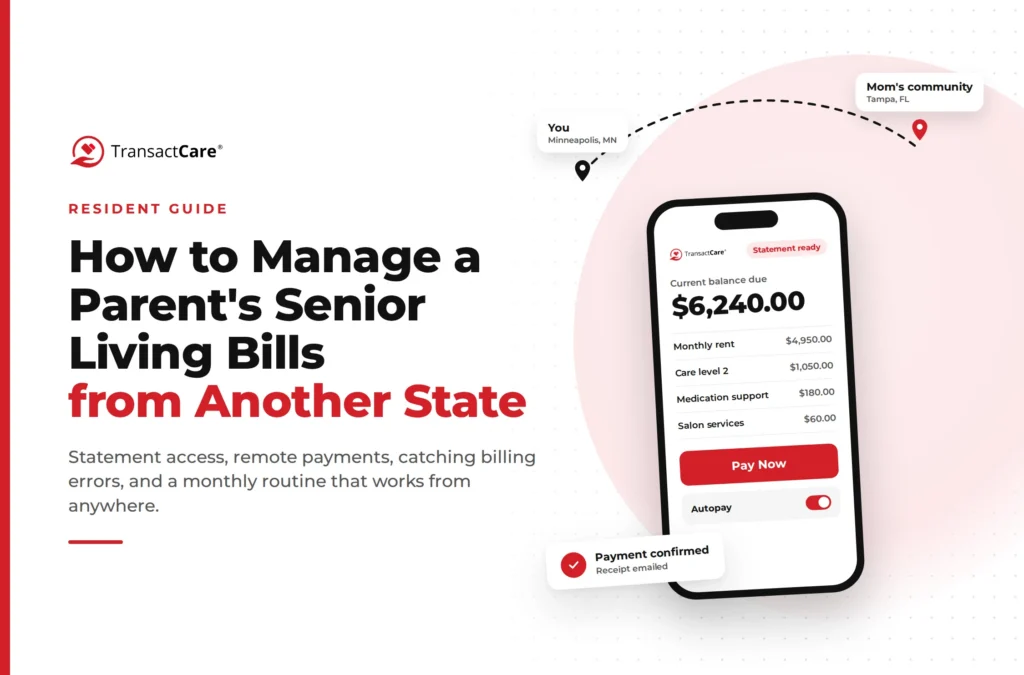
Your parent lives in Florida. You live in Minnesota. Or, your parent is in Arizona and you are in New York, which means that by the time you get off work, the billing office in Phoenix has already gone home for the day and taken all of your questions with it.
The distance does not need to be coast to coast for this to become a problem. It just needs to be far enough that you cannot swing by the business office on a Tuesday afternoon, sit down with the billing manager, and sort out why this month’s statement is $400 higher than last month’s. Once that option is off the table, every billing question becomes a phone call, every phone call becomes a voicemail, and every voicemail becomes a small act of faith.
You have plenty of company. According to the Family Caregiver Alliance, somewhere between three and six million Americans are long-distance caregivers, living an average of 450 miles from the person they care for. And the broader caregiving population keeps growing. The 2025 Caregiving in the US report from AARP and the National Alliance for Caregiving found that 63 million Americans are now family caregivers, a nearly 50 percent increase since 2015. A meaningful slice of those caregivers are reviewing bills they have not seen, for care they did not witness, at a facility they visit a few times a year.
The good news is that managing a parent’s senior living bill from another state is completely doable. As AARP notes in its guide to long-distance caregiving, online banking and digital tools have made remote financial management far more realistic than it used to be, provided you have the proper permissions and signed documents in place. The less good news is that “doable” and “easy” are not the same thing, and the difference usually comes down to setup. This guide walks through that setup from start to finish: the legal documents, the billing office relationship, statement access, payment methods, error detection, sibling coordination, and the monthly routine that keeps the whole thing from quietly falling apart.
Can You Manage a Parent’s Senior Living Bills from Another State?
Yes. Nothing about senior living billing legally requires the person paying the bill to live nearby. What it requires is legal authority to act on your parent’s behalf, a reliable way to see what is owed, a reliable way to pay it, and a reliable way to find out when something changes. Geography only becomes a problem when one of those four things is missing, which, unfortunately, is most of the time.
The families who struggle with long-distance billing are rarely struggling because of the distance itself. They are struggling because the facility mails paper statements to a room their parent no longer checks, accepts payment only by check, and communicates care changes by phone during hours when the family member is at work. Research summarized by the Center for Retirement Research at Boston College found that 56 percent of employed family caregivers have had to go in late, leave early, or take time off because of caregiving responsibilities. Add a time zone gap and a billing office that closes at 4:30, and it becomes clear why so many remote payors feel like they are always a step behind.
Fix the infrastructure and the distance stops mattering nearly as much. The rest of this guide is about fixing the infrastructure.
Why Long-Distance Billing Gets Messy So Quickly
If you have not yet managed a senior living bill from several states away, here is roughly how it goes when nothing has been set up intentionally.
The monthly statement is generated and mailed to the facility address, or left in your parent’s room, or sent to an email account nobody monitors. Your parent does not read it, or reads it and forgets about it, or files it somewhere creative. You learn about the bill when a family friend mentions it, when a past-due notice shows up, or when the billing office calls to ask where the payment is. You now have a few days to pay a bill you have not seen, for charges you have not reviewed, using a check that will take three to five business days to arrive. You call to confirm the check was received. You leave a voicemail. You get a call back two days later while you are in a meeting. You spend the rest of the month wondering whether a late fee was applied and whether last month’s payment ever posted.
Variable billing makes all of this harder. As we explain in our guide on how to read your senior living bill, senior living statements are not fixed amounts. Care levels change when your parent’s needs change. Dining charges, transportation, and incidentals fluctuate month to month. When you are not there to see those changes happen, they show up on the statement with no context, and a care level reassessment discussed at a meeting you were never told about becomes a line item you have to reverse-engineer from 800 miles away.
Then there are the financial side effects. The 2025 AARP caregiving report found that half of family caregivers report negative financial impacts from caregiving, and a quarter have taken on debt as a result. Long-distance caregivers tend to carry extra costs on top of that, including travel, missed work, and the occasional emergency flight when a phone call is not enough. Every avoidable late fee, every billing error that goes unnoticed for three months, and every day spent chasing confirmation adds weight to a load that is already heavy. None of it is catastrophic on its own. Together, it wears people down.
What Legal Documents Do You Need to Manage a Parent’s Bills Remotely?
Before you can manage anything, you need documented authority to do it. Informal arrangements work right up until the moment they do not, and that moment usually arrives at an inconvenient time, like when a bank refuses to talk to you or a facility will not discuss the account because you are not on file.
- Financial power of attorney. This is the foundational document. A durable financial power of attorney gives you legal authority to access your parent’s accounts, pay bills, and act on their behalf in financial matters. As CNBC reports in its coverage of financial caregiving, this document must be created before any material cognitive decline occurs. Once a parent loses legal capacity, they can no longer sign a POA, and the remaining option is a court-supervised guardianship, which is slower, more expensive, and considerably less fun than it sounds. According to the Alzheimer’s Association, roughly one in nine people age 65 and older has Alzheimer’s disease, so this is not a task to put on the “someday” list.
- Institution-specific forms. A signed POA does not automatically open every door. CNBC also notes that some banks and investment custodians will not recognize a general power of attorney unless their own specific form is attached to the account. Call each institution where your parent holds money and ask what they require before you need it. Discovering this during a billing emergency is a character-building experience nobody needs.
- Health care documents. Financial authority lets you pay the bill. It does not necessarily let you understand why the bill changed. A health care power of attorney and a HIPAA authorization allow you to receive information about your parent’s care, which is often the only way to make sense of a care level increase. A Place for Mom points out that these documents are particularly important for seniors who rely on more distant relatives to oversee their care, since those relatives may not know the day-to-day details on their own.
- A copy on file with the facility. This is the step families skip most often. Once your POA is in place, send a copy to the facility’s business office, confirm they received it, and ask how your name and contact information appear in their billing system. Many families assume the facility already knows. Many facilities do not.
One more rule worth tattooing somewhere visible: never commingle your parent’s money with your own. AgingCare calls this the number one rule for family members managing a parent’s finances, because mixing funds complicates your records and can expose you to accusations of financial elder abuse. Pay your parent’s bills from your parent’s accounts, keep receipts, and keep everything separate.
It is also worth pulling out the admission agreement you or your parent signed at move-in and reading the financial responsibility section, so you know exactly what your role obligates you to. And if private resources are starting to run thin, our post on what to do if you can’t afford your parent’s senior living bill covers the options available before that becomes a crisis.
How to Build a Working Relationship with the Billing Office from Out of State
The business office at your parent’s community is going to be one of the most important relationships in your life for the foreseeable future. You may never meet these people in person. Treat the relationship like it matters anyway, because it does.
Start by getting a name, not just a department. Ask who handles your parent’s account specifically, and get a direct email address for that person rather than relying on the main phone line. When you have a question about a charge, you want to send it to someone who knows the account, not into a general inbox where it may sit until someone draws the short straw.
Next, set expectations early. Tell the billing office that you are managing the account from out of state, that you are the primary financial contact, and that you would like all billing-related communication sent to you in writing. Ask them to notify you by email before any care level change takes effect, not after it shows up on a statement. Most facilities will accommodate reasonable requests like this, especially when they are made proactively rather than in the middle of a dispute.
Finally, default to email for anything that matters. Phone calls are fine for quick questions, but they leave no record. If a billing office employee tells you on the phone that a late fee will be waived, that promise lives only in your memory and theirs, and memories are notoriously bad at holding up in billing disputes. A short follow-up email summarizing what was agreed (“Thanks for confirming the late fee on the March statement will be reversed”) takes thirty seconds and saves hours later.
How to Get Senior Living Statements Emailed Instead of Mailed
If your parent’s statements are still arriving on paper, fixing that is the single highest-value change you can make as a long-distance payor. A paper statement mailed to a facility room is essentially a statement mailed to nobody.
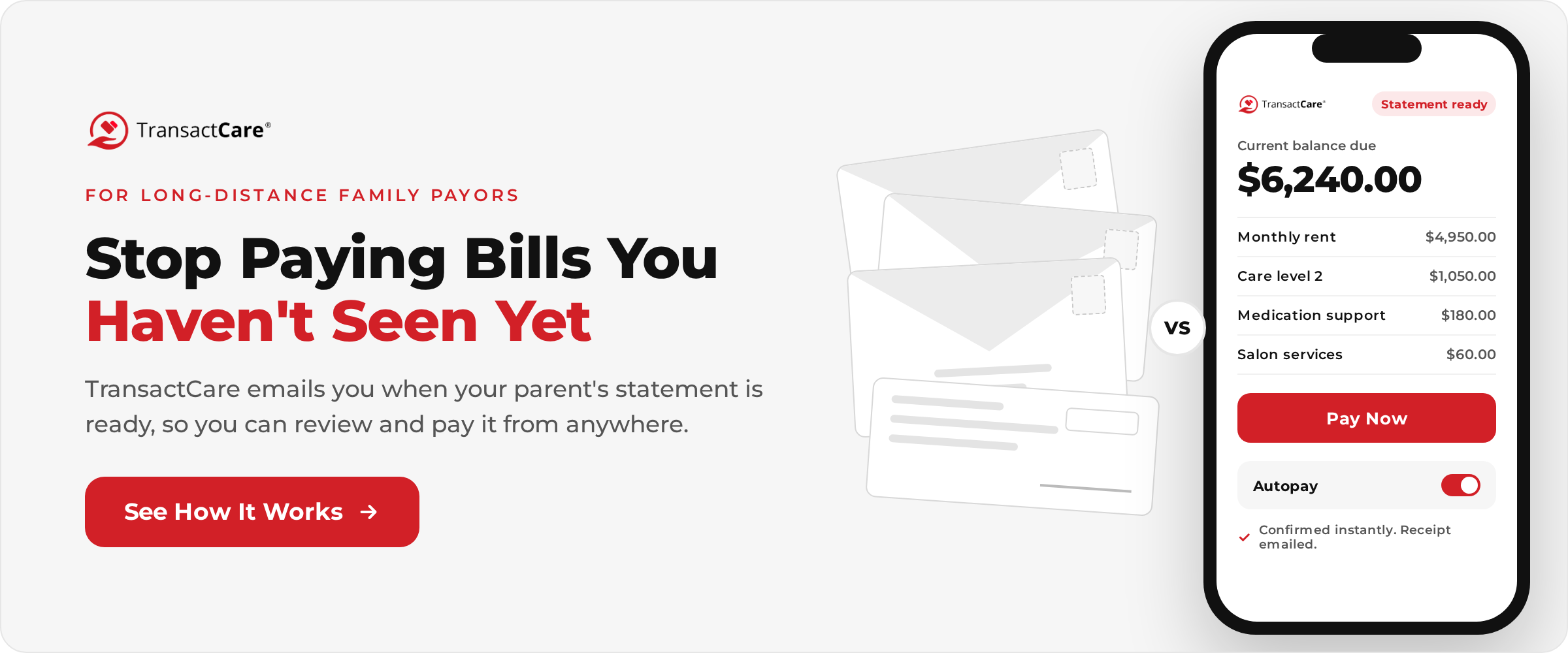
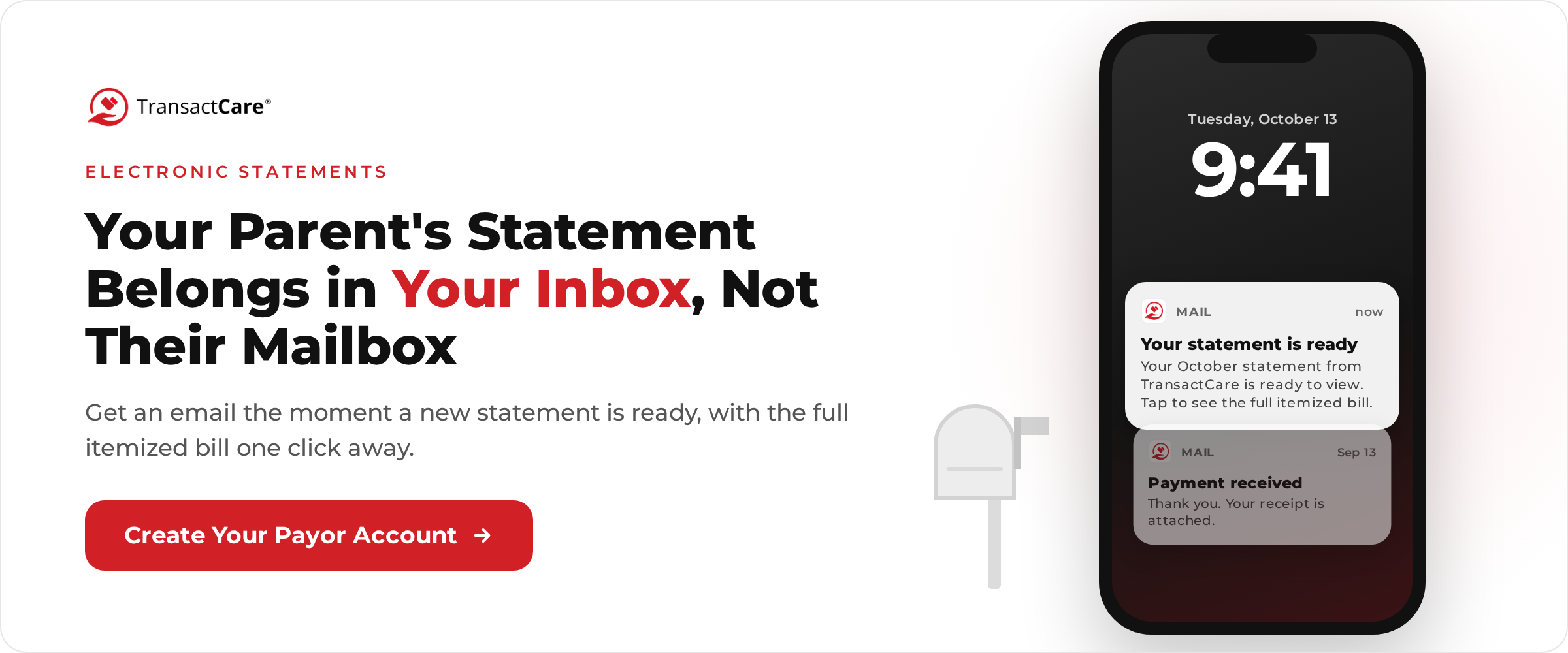
Contact the billing office and request electronic statement delivery to your email address. If the facility uses a payor portal, ask to be enrolled so you can view statements whenever you need them rather than waiting for something to arrive. Communities that bill through PointClickCare® often have electronic statement options available, particularly if they use an integrated payment platform alongside it.
The difference in speed is not trivial. In one example TransactCare® documented with Oaks Senior Living, moving to electronic delivery meant statements reached families five days faster than before. For a remote payor, five extra days is the difference between reviewing a statement calmly and paying it in a panic. Our post on electronic statements in senior living covers the broader shift away from paper billing if you want more context to share with the facility.
If the business office has never set up electronic delivery for a family before, expect a little friction. Someone may need to figure out who is allowed to approve it. Be patient but persistent, and frame the request around a shared goal: you want to pay on time, and you cannot do that reliably if you do not see the bill until it is nearly due. The facility wants that too.
What Is the Best Way to Pay a Senior Living Bill from Another State?
Once you can see the statement, you need a way to pay it that does not depend on the postal service and good luck. Here is how the common options stack up for long-distance payors, from most useful to least.
- A payor portal with electronic payment. This is the gold standard. You log in, review the current itemized statement, and pay by card or bank account in a few clicks, with confirmation generated immediately. If your parent’s facility uses TransactCare, that is exactly how it works: you receive an email when the statement is ready, view the full itemized bill online, and pay by credit card, debit card, ACH, or eCheck from any device. According to TransactCare’s payor page, payments are confirmed instantly and eCheck payments are free of credit card fees. For someone managing a bill from three time zones away, “confirmed instantly” is a much better phrase than “probably arrived Thursday.”
- ACH through your bank’s bill pay. If the facility does not have a portal, you can usually set the facility up as a payee in your parent’s online banking and send electronic transfers. This is a real improvement over mailing checks yourself. The limitation is that your bank has no idea what the statement says, so you are paying an amount you calculated rather than an amount the facility billed. Pair this with electronic statement delivery so you always know the correct number before you send it.
- Credit card by phone. Convenient in a pinch, but many facilities charge processing fees, and phone payments create less documentation than a portal. On a bill that often runs well over $6,000 a month, a card fee can add up quickly. Ask about fees before making this your default.
- Mailing a check. Technically a payment method. Practically a hope. Checks are slow to arrive, impossible to track in real time, and require a follow-up call to confirm they posted. If this is currently your only option, keep reading, because there is a section below on what to do about it.
Whatever method you use, save a record of every payment. As the person managing your parent’s finances, your documentation is what demonstrates that you handled things responsibly if a question ever comes up.
Should You Set Up AutoPay for a Parent’s Senior Living Bill?
For most long-distance payors, yes. Autopay removes the single most common cause of late payments, which is a busy person forgetting, and it does so without requiring you to remember anything from another state.
The catch is that senior living bills are not fixed. If your autopay is set to a flat monthly amount and a care level increase bumps the bill by a few hundred dollars, the draft will come up short and the difference will quietly roll forward as a past-due balance. The safer setup is autopay that charges the actual statement balance each cycle, so the payment adjusts automatically when the bill does. TransactCare’s autopay works this way: it charges your preferred payment method each month when the bill is ready and emails a receipt after every automatic payment.
Even with autopay running, do not stop looking at the statement. Autopay makes sure the bill gets paid. It does not make sure the bill is correct. A five-minute monthly review is still your best defense against errors. Our full guide on how to set up automatic payments for your parent’s senior living bill covers configuration, common pitfalls, and what to watch for once autopay is live.
How to Catch Billing Errors When You Are Not There in Person
Billing errors happen at every facility, including good ones. Charges get posted to the wrong account, services get billed after they were discontinued, and care level changes get applied before anyone tells the family. When you live nearby, you often catch these things through casual conversation. When you live far away, the statement is your only window, so it pays to read it with some care.
Each month, compare the new statement to the previous one. Look first at the recurring charges, like base rent and care level fees, and confirm they match what you expect. Then scan the variable charges. If you see a charge you do not recognize, a care level that changed without notice, or a service your parent says they are not using, flag it right away.
When you flag something, do it in writing. Email the billing office with the specific charge, the date it appeared, and the amount, and ask what it covers. Written inquiries create a record, get routed to the right person more reliably, and are much easier to reference later than “I called sometime in April and talked to someone named maybe Linda.”
It also helps to cross-check with a local source when you can. If your parent is able to have a quick conversation about what services they are receiving, ask. If a sibling, friend, or care manager visits regularly, ask them too. A charge for daily medication assistance makes more sense when you know your parent recently started a new prescription. A charge for transportation makes less sense when your parent has not left the building in a month.
Errors caught in the current billing cycle are usually simple to fix. Errors caught three cycles later tend to involve a lot more back-and-forth. The monthly review is not glamorous, but it is cheap insurance.
How to Coordinate Bill Payment with Siblings in Different States
Many families do not have one long-distance payor. They have three, spread across three states, with three opinions about how things should be handled. If that sounds familiar, a little structure goes a long way.
Decide who the primary financial contact is and make sure the facility knows. Billing offices do not want to field conflicting instructions from multiple family members, and you do not want payments falling through the cracks because everyone assumed someone else handled it. One person should own the account relationship, even if several people contribute money.
If siblings are contributing to the cost, agree in writing on who pays what and when. Keep in mind that your parent’s own funds should cover their own bills first, and contributions from family members should be tracked clearly so there is no confusion later about whose money went where.
Share information, not just costs. Forward the monthly statement to anyone who is contributing, or share a summary. Transparency heads off a surprising number of family arguments. It is much harder to be upset about a care level increase when you saw the statement and the explanation at the same time as everyone else.
Do You Need a Geriatric Care Manager?
Sometimes the missing piece is not a document or a portal. It is a person who can actually walk into the building.
A geriatric care manager, sometimes called an aging life care professional, is a trained specialist who helps coordinate care for older adults. U.S. News describes their role as acting as a liaison among family, care providers, and other professionals, including elder law attorneys. For long-distance families, that often means attending care meetings, checking in on your parent, and calling you when something changes, which in turn means billing-relevant changes reach you before they reach the statement.
Bethesda Health Group notes that care managers are especially helpful when family members live in another city or state, and that because they see the senior regularly, they often spot issues families would otherwise miss. They are not usually covered by Medicare or private insurance, and rates typically range from about $100 to $250 per hour, depending on location and experience. For families who are currently flying in every time something needs attention, a care manager can end up costing less than the airfare.
If you want to explore this option, the Aging Life Care Association maintains a searchable directory of certified care managers by location.
Not every family needs one. If you have a reliable sibling or friend nearby who visits regularly and is willing to keep you in the loop, that may be enough. The goal is simply to have someone local who can see what you cannot.
What to Do If Your Parent’s Facility Does Not Offer Online Payments
This is where a lot of long-distance families get stuck. You have done everything right on your end, and the facility still only accepts checks and still only mails paper statements. It is frustrating, and it is also more fixable than it looks.
Start by asking the business office directly what electronic options exist. Sometimes they have more capability than they advertise, like email statements or ACH instructions they can provide on request. If the answer is still no, escalate politely to the Executive Director. Frame it as a practical problem: you manage the account from out of state, and you need to be able to see statements and pay electronically to stay current. You are not asking for a favor. You are asking for the kind of billing access that nearly every other monthly bill in your life already provides.
Then bring a solution. If the facility uses PointClickCare, which many senior living communities do, point them to TransactCare. TransactCare is built specifically for senior living facilities that use PointClickCare, and according to our facilities page, onboarding typically takes about one week with no IT project required. Statements are generated inside PointClickCare as part of the facility’s existing workflow and sent to families automatically, and families pay online by credit card, debit card, ACH, or eCheck. For the business office, that means less time chasing checks. For you, it means you can stop being the person who calls every month to ask whether the envelope made it.
Useful links to send the billing office or Executive Director:
- transactcare.com/facilities explains how the platform works from the facility side.
- transactcare.com/payors shows what the family experience looks like.
- support.transactcare.com answers common questions from both families and staff.
Families who ask for better billing tools are often the reason facilities adopt them. If enough payors ask the same question, it tends to move up the priority list.
A Simple Monthly Routine for Long-Distance Payors
The biggest risk in long-distance billing is not one dramatic mistake. It is a slow drift: a skipped review here, a late payment there, a care level change nobody caught for two months. The fix is a routine boring enough to be reliable.
- When the statement arrives, open it within a few days. Compare it to last month’s. Confirm the recurring charges and scan the variable ones.
- If something looks off, email the billing office the same day with the specific charge and your question. Do not wait until the due date.
- Before the due date, confirm payment. If you use autopay, make sure it ran. If you pay manually, pay early enough that it posts on time.
- After payment, save the confirmation. If your parent’s facility uses TransactCare, your payment history is stored in the portal automatically, which makes this step considerably less tedious.
- Once a quarter, check in with your local contact or care manager about any care changes coming up, and confirm the facility still has your current contact information on file.
The whole routine takes thirty to forty-five minutes a month. That is a small price for not having to wonder, every few weeks, whether something has gone wrong without you knowing.
If a balance has already started building beyond what your parent can cover, do not wait for it to fix itself. Our guide on what to do if you can’t afford your parent’s senior living bill covers communication strategies, payment plans, and financial resources worth exploring. If you are weighing longer-term funding options, our post on private pay versus Medicaid for senior living and our guide on whether you can use an HSA to pay for assisted living may also help.
Why TransactCare Is Built for Long-Distance Payors
Everything in this guide comes back to the same three needs: see the bill, pay the bill, and keep a record. Long-distance payors struggle when any one of those depends on paper, phone calls, or physical presence. TransactCare was built to remove that dependency.
TransactCare is a payment platform designed for senior living facilities that use PointClickCare. Because statements are generated directly from the facility’s PointClickCare records, the bill you see reflects the same system the facility uses to manage your parent’s account. When the statement is ready, you get an email. You log in from any device, review the full itemized statement, and pay by credit card, debit card, ACH, or eCheck. Payments are confirmed instantly, and you can set up AutoPay so the bill is paid each month when it is ready, with an emailed receipt every time. Your payment history stays in the portal, which quietly takes care of the recordkeeping that every POA should be doing anyway.
Two details matter especially when you live far away. First, TransactCare’s support team is staffed around the clock by US-based billing specialists, which means a billing question at 9 PM does not have to wait for the facility’s office to reopen. Second, TransactCare is a Validated PCI DSS Level 1 Service Provider with HIPAA-aligned controls, so the financial and health information moving through it is protected to a high standard.
If your parent’s facility already uses TransactCare, you can register for a payor account in about two minutes by searching for the facility and entering your account information. If you are not sure whether it does, ask the business office. And if it does not, you now know exactly what to ask for.